
Training different dogs will often follow fairly similar patterns. Each dog is of course unique, but it would be a mistake to think that there isn’t some underlying theme that can be applied. Finding those patterns and themes, taking them and using them with different dogs, understanding where the mechanism seizes or catches and doesn’t flow correctly, is all part of working with dogs. Some trainers have tried to describe the paths that they follow and I’m always curious to try and understand the route they take. It’s as if there is a map of connections, thousands of possible links between a “here” and a “there”. Each of those lines have many possibilities for errors, wrong turns that can lead you astray, like trying to follow the safe passage through the rocks to reach the harbour. It concerns me to hear some trainers describe their path and they seem so troubled by staying safely on course that they’ve forgotten where they’re heading. But while they’re blindly heading who knows where I thought I’d attempt to share what I consider to be some of the best routes, highlighting perhaps some of the dangers along the way. As far as I can tell these are uncharted waters although many dogs have passed this way…
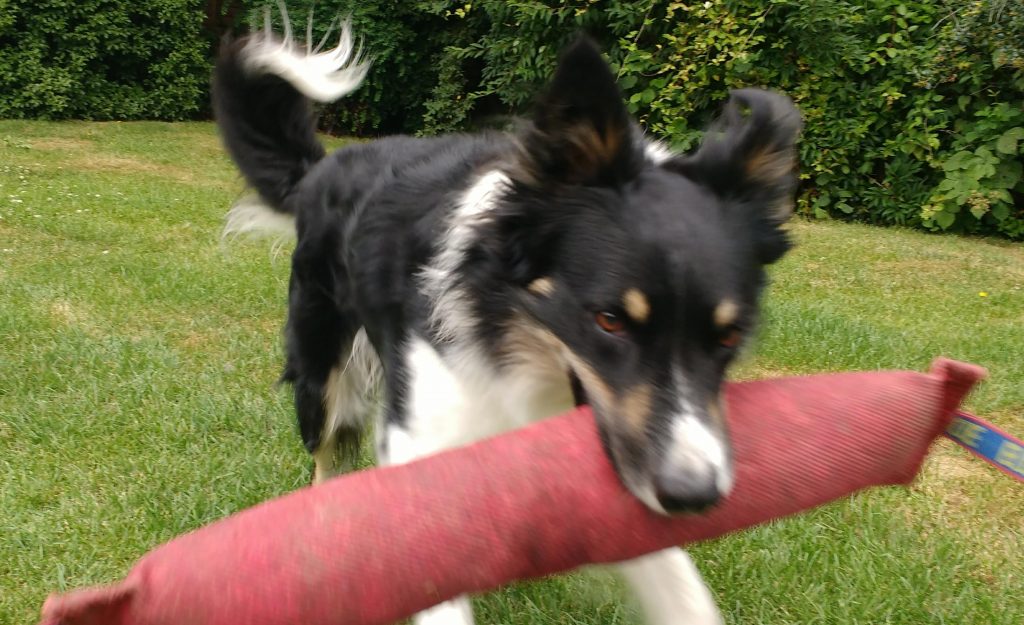
The route I want to describe here is through a playful interaction with a toy. Simple enough and probably all dogs have done something like this. There are so many possibilities here that it’s almost impossible to think of where to start, so I figure we should jump right in with some sort of scheme to give us a point from which to begin. How about this, the dog has a toy… where can we go from here? This is starting to feel like a quest already. Long ago I remember playing the first text based adventure game, Colossal Cave, where you had to type in commands and discover the route through a maze of passages. Things would suddenly happen like “a pirate appears and steals your treasure”… Anyway, the dog has a toy, where can we go from here… well the opposite pattern would be “the handler has a toy” so can we head to this?
Here’s one of our first traps though. The quick route from A to B isn’t necessarily the one to take and can miss a whole bunch of useful things. The dog that throws the ball at your feet and looks for another go… and it all seems so appealing. Quite often, in the normal run of things, the ball gets picked up and thrown. The dog gets to chase again, the loop repeats, the dog gets tired, the ball goes away, everyone’s happy. There it could end too but it sometimes gets stuck in this loop. There is a fine line here that frequently gets crossed into addiction. The stimulation of the game is intoxicating. A heady mix of adrenaline and biting, buzz and bite in a twisted pair repeating and fizzing, another, another, more and more. Without a grounding sensation bringing it all down to earth there can be no let up, no remorse and the buzz and bite are in need of feeding, fuelling, further buzz, more bite…
OK, so more carry is required. Can we go for more carry? Don’t drop the ball, carry it! Closer to a more rounded fulfilling retrieve, with less of the problem from stimulation addiction. Holding the toy, moving with the toy. Using a line can help here, either on the dog or on the toy. Pulling the dog through resistance, getting a tug game going and then taking it further, as if climbing over a hill then freewheeling down the other side. Or the alternative is acceptable too, where the dog digs in and refuses to budge. Both need a handler who presents little in the way of pressure, turning away completely to focus entirely on escape. Escape is an important quality throughout these games, using the prey-like sensation of evading capture, which of course the dog can always overcome.
Building this desire can take a dog into realms previously unimagined, where the toy becomes increasingly valued and perhaps worthy of guarding. This is another dangerous path along which we should tread carefully. However the benefits outweigh the costs and with the right handling possessiveness can be a positive trait. In order to perform a retrieve the dog requires some desire for the article. It would be of little use sending a dog to something that isn’t desired and conversely we should practise retrieve with things that are desired otherwise possessiveness could erupt on something they do want. We are always asking dogs to follow the difficult route and to retrieve is the difficult route. Retrievers are asked to head out into the field, to get something they really want, then return with it and give it up quite happily. So we need to manage possessiveness, develop it safely without disregarding it.
The bark is a useful safety net here. Building desire then allowing that desire to be used successfully. Getting closer to our goal of handler having the toy we can look for a bark to stay safe. Eventually we want the dog to eagerly push the toy into the handler, the transfer is mediated with a bark. Back to the start of the quest we had a dog with a toy. If the dog has “stopped and dropped”, so movement has ceased and the toy is now on the floor, being able to switch to a food loop can soften the dog to our presence. The alternative is to stalk and covet the toy, which can trigger more hold and carry. Moving in to a food loop though, allows us to close in on our goal of handler with toy. The food loop can be initiated with an upturned hand, cupping something to eat or just the promise of food. The manner of speaking can help too, using a soft soothing in contrast to the spiky and nervous antagonism of trying to steal away with the toy. The expectation of food allows the handler to move in closer, and the bark is part of a commitment to the handler from the dog, transferring the desire from the toy and allowing projection without movement, a safe expression of guarding the toy.
We’re closing in on our goal of handler with toy and there is a shortcut here that can get us there quickly. Asking the dog to wait and being able to pick up the toy is a possible strategy. There is the chance that it can damage the desire and enthusiasm built up through the exercise so take care not to abuse this position and act with due deference to the dog’s acceptance. A certain amount of nervousness or stealthiness is useful in the early phases of training to keep the dog’s confidence in re-establishing a hold of the prey. Too often the toy gets abruptly taken and the dog becomes unsure in taking the chance to grab it from the handler when the opportunity arises.
This shortcut though avoids another route, where the dog closes in on the handler and pushes the toy in too. A trickier route with greater rewards, this will come through with the encouragement to bark. The bark, the bite and the jumping up are the triumvirate of dog behaviours that link together and turn on each other in a mix of outputs that are the outward expression of the same internal projection. This means they are at root very similar, and can be switched and swapped quite easily. Encouraging a dog to jump but then turning the dial to bark isn’t difficult, and encouraging a jump but then switching to biting a toy is a similar straightforward substitution. With barking in the mix, along with the lift from jumping, the toy can be pushed in to the handler. The fight to hold on can be increased using some slap and retreat, hitting the toy then suddenly withdrawing, like playing a game of tag in the playground. Also pushing the dog away, through the toy, increases the power used to approach.
This brings us then to the goal, following the path from our starting point, where the dog has a toy, through to the opposite pole. We have reached the furthest place, the flip-side, crossed the playing field and reversed the view, from where the only path leads back again. Like the change of server in a game of tennis, or alternating periods of possession in football, the handler is now in touch with the toy. Here we should also look carefully though at how the changeover occurs. With hands on the toy it could be tempting to just take control and remove it. The game however should be seen as more important than the toy. The game doesn’t work if the players get frustrated with the alternating fortunes within the play. The pattern oscillates, swinging from side to side, as periods of ascendancy are experienced first with one then the other. Feeling and turning on the ebb and flow, recognising where the extremes are reached, and knowing that each cycle gets repeated again and again. On the point of changeover we don’t want to frustrate and annoy, withholding the toy and creating conflict. However, some frustration is useful to generate motive force, so the balance is needed between two positions and a smooth and flowing transition indicates minimal friction. Teaching the dog to drop is the end result, where the promise of continuing the game is the best reward. The dog shaking and killing the prize is a win for the dog’s team, even better is a chance to play the game.
Leave a Reply